Sunday, December 10, 2017

1973 Minnesota Twins - 81-81 - 3rd Pl AL West - 13GB

The Designated Hitter was introduced to baseball, but the 907,499 who viewed the Twins in 1973 did not see Harmon Killebrew in the role he was meant to play. Instead they saw the hobbled Tony Oliva, who would play out his remaining seasons as the Designated Hitter. Killebrew, himself slowed by injuries, would hit only 5 homers for the season. Rod Carew won his third batting crown with a .350 average, and was joined at the All-Star game by Bert Blyleven, who set five team records in the 1973 season with his 325 innings and 258 strikeouts to go with 25 complete games, 9 shutouts and holding opponents to a .252 batting average while compiling a monster 20-17 record.


The Twins hung around the AL West race well into July.  As late as July 2nd they had a share of the lead, but for some reason fans thought this team was more of a pretender than a contender judging by their attendance which was 10th in the league and under a million fans.  Contenders don't draw flies, which this team did.  By the beginning of August they were still only 4 1/2 out, but a 7-21 stretch that ran from July 29th through Augst 26th left them 16 1/2 back and dead in the water.  Watching 37 year old slugger and future HOF'er Harmon Killebrew fade right before everyone's eyes was painful to watch.  It also hurt the team's chances to contend, since he hit only 5 homers and batter .242 to go along with his somewhat average glove play.  Fans and ownership thought former ace Jim Kaat (11-12, 4.41) was kaput as well, so they shipped him off to the Chisox as the team faded.  Blyleven started 40 games and completed 25.  They needed him to start 80 to have a chance.  The rotation after him and Kaat included .500 type pitchers like Joe Decker (10-10, 4.17), Dick Woodson (10-8, 3.95) and Bill Hands (7-10, 3.49).  Ray Corbin (8-5, 14sv) and Bill Campbell (7sv) were solid out of the pen.  Based on the numbers put up by this team manager Frank Quillici was lucky to get them to .500.

I create 15 new cards to complete the set, which is a low number for a team that finished in the middle of the pack.

Campbell started the season in AAA-Tacoma and started 18 games with a 10-5, 3.65 record.  When the Twins called him up he was used primarily out of the pen going 3-3, 3.14 with 7 saves.  His sophomore year provided zero jinxes with a 8-7, 2.62, 19sv effort.  1976 was the perfect time for him to go 17-5, 3.01 with 20 saves, because free agency became a reality after that and he signed a huge contract with the Red Sox.  Campbell lost his status as an elite reliever after his 31 save season in 1977.  Still he had financial security and te ability to eat up innings all the way until 1987.
After 7 seasons as a frontline starter for the Cubs, Hands moved to the AL and went 7-10, 3.49 for the Twins.  No longer a guy who could be relied upon for 200+ innings and a winning record Hands was used as a swingman and a spot starter for the final two seasons of his 11 year career.  He was traded from the Twins to the Rangers in the beginning of September of 1974 for the pennant drive.  In his 2 starts he won both games with a 1.93, but the Rangers fell short.  His final season, 1975 was subpar (6-7, 4.02).  Rather than try to hang on he decided to retire and head back to Jersey.
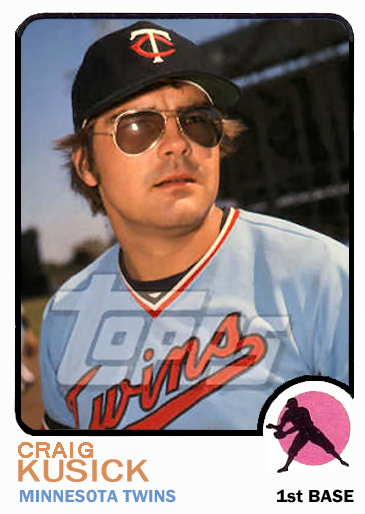
"Mongo" spent all but one of his 7 major league seasons with the Twins.  A big burly 6'3" guy who was expected to hit a lot of homers Kusick never had more than 268 AB's in any season.  After hitting 27 homers and knocking in 104  runs in AAA Tacoma he got his first taste of major league baseball in 1973.  He hit an even .250 in 15 September games.  1974 saw him split time between Tacoma and Minnesota, where he batted 90 points lower than his AAA average.   On July 25, 1979 the Blue Jays purchased his contract from Minnesota where he was hitting just .241.  He didn't fare much better north of the border hitting just .204.  After the Jays cut him the Padres signed him and sent him to AAA-Hawaii where he hit .305 with 17 homers.  The following season he was hitting .272 when he was traded to the Tigers and sent to Evansville, IN.  No knock on Evansville, but getting traded there from Hawaii is a bit disappointing.
First thing my 12 year old brain was thinking, "Is he related to Barney?"  My 52 year old brain said, "Really?"  After starting for 3 years at the University of Michigan as a basketball player he chose baseball for his profession.  In 2 major league seasons (1973-74) he posted a combined 3-2, 5.43 record.  Maybe he should have signed with the Bucks, who drafted him in 1971.  After baseball he became a highly successful HS basketball coach at Clarkston HS in Michigan.
Bane was 0-5 with a 4.92 ERA in 23 games (60+ IP) for the Twinkies during the '73 season.  The 21 year old was a first round draft pick and was drop shipped straight from the ASU campus right into Bloomington.  Obviously they thought of his a "our David Clyde".  Well we all know how bad the Clyde story turned out, and this one was no different.  The Twins were a bit smarter than the Rangers and saw the error in their ways and made sure that Bane spent the full '74 season in AAA-Tacoma (10-8, 4.18).  Since his ERA and walks were high he started out '75 back in Tacoma and went 15-11, 4.03.  Very similar to his numbers from 1974.  As a late season callup he gave hope to Twin fas with 4 positive starts (3-1, 2.86).  What the non-seamheads didn't notice was that during that stretch he struck out 24, but walked 39.  Those numbers reversed aren't even good for a major league pitcher.  When he started '76 with more losses than wins (4-7, 5.11) he was returned to Tacoma for the next two seasons where he bombed.  The White Sox took a shot with him in 1978 and his AAA-Iowa numbers showed a modest improvement.  After taking off all of 1979 he gave it one more go in 1980 with Wichita (CUB) and Omaha (KCR), but he just didn't have it.  And so goes the tale of another #1 pick that just didn't pan out.
"Guido's" teams in Minnesota always hung around .500.  Sometimes they were a bit over and more often than not a bit under.  They were purely average and very pedestrian.  If location is important in Real Estate, then timing is important in baseball.  Quilici had the bad timing to get the Twins job at the age of 33 in 1972.  He inherited a team that had been solid contenders for the past decade, but was now long in the tooth, plus he hat the unenviable task of managing his former teammates...some (like Killebrew), who were older than him.  After keeping the Twins afloat using putty, tape and spit in 1974 Quilici could not find any magic the following year and was fired, which was probably a relief for him since working for cheapo owner Cal Griffith wasn't conducive to any manager's success.  At 36 years of age and with a lot of life ahead Guido became a Twins broadcaster and a successful business man.
By 1973 Mitterwald was in his 7th and final year as a Twin.  With a roller coaster like career where he would be horrible one season and rise up to mediocrity the next Mitterwald saved his best season for the end hitting .259 with 16 homers in 125 games.  Cheapo owner Cal Griffith was nobody's fool and he decided to sell high and get the most value for his 29 year old backstop coming off a career (his) year.  Georgie was sent to the Cubs for their aging catcher Randy Hundley who in one season turned out to be Minnesota's version of the Hindenburg (.193 in 32 games), while Mitterwald hit .251 at Wrigley.
Jerry Terrell was a surprise 26 year old rookie callup who got into 124 games and hit a solid .265 for the '73 Twins thanks to the rash of injuries that the team experienced.  Terrell, who was more flexible than Olga Korbut, played every postion except catcher during his 7 year career as a utilityman.  Known for his hustle he was voted the Twins 1973 top rookie.  After hitting just .224 in 1977 he was shipped off to KC where he was used sparingly and survied 3 more seasons.  In his final season, 1980, he came out of the gate hitting .063 and was banished to Omaha-AAA where he finished out his professional baseball career hitting .288.  Terrell was deeply respected by Royals management, in fact he was respected by all of baseball.  He was called up in September and was allowed to sit on the bench in uniform during the Royals post season run.    Despite the fact that Terrell spent much of the 1980 season in the minor leagues, he was presented with the 1980 Danny Thompson Award, an award given annually for “exemplary Christian spirit” in baseball.

When doing my research on George Henry "Joe" Decker I found out this little tidbit (from the Find a Grave website):  Joe Decker was a hard thrower, but tended to have streaks of wildness, so much so, that in spring training, his teammates would sometimes refused to bat against him.  In 1973, his first season with the Twins, he was 10-10 with a 4.17 ERA. The next year proved to be the watershed mark in his career. He was 16-14 with a 3.29 ERA, with 37 games started, tallying 11 complete games and 1 shutout, but would never approached these figures again. After 1974 performance, he explained his success: "I try to tranquilize myself when I pitch. If I'm lethargic, I have better stuff." He started only 10 games in 1975, going 1-3.  He was released by the Twins on June 25, 1976, after having compiled a 2-7 record. After that it was pack your bags and travel from team to team time with is final destination the expansion Mariners right after he returned from Mexico

After playing mediocre ball for 3 horrible Phillies teams (1970-72) Lis wound up in the right place at the right time, Minnesota.  For the price tag of one disgruntled Cesar Tovar the Twins received Lis and two broken down pitchers (Reynolds & Sanders).  Lis was brough on as an insurance policy in case something happened to the aging Killebrew.  All-State insurance he was not.  Lis was not a charter member of the "good hands people".  In fact he wasn't even a good bat person, which his .245 average with 9 homers would attest to.  When he started off weak in 1974 he was to the Indians where he finished even slower (.202).  The following two seasons (1975 & 1976) saw him hit over .300 in very limited action (29 games combined).  In fact that's how Lis looked good, when he wasn't seen much on the major league level.  On the minor league level he hit over 30 homers, which was the 4th time in his career that he accomplished that.  If only he could get Triple-A pitching to the majors or face the 1978 A's every day, Lis was going to have problems.  Lis decided to take his talents to Japan, where so many AAAA Americans migrated to become stars.  This was not the case as he hit .206, which resulted in his deportation to Evansville, IN (AAA-DET) where he had a nice swan song season (.292-16-80).

Sanders was one of those broken down pitchers traded along with Lis to the Twins for Tovar.  Sanders earned eight saves for the Twins by the end of May 1973 despite a relatively high 5.60 ERA. He lost the closer's job to Ray Corbin, and was placed on waivers. He was soon claimed by the Cleveland Indians, and pitched far more respectably with his new club, going 5-1 with a 1.65 ERA and five saves. Back-to-back poor performances against the Boston Red Sox and Baltimore Orioles led to his release in 1974.  He soon signed a minor league deal with the California Angels, and was promoted to the big league club after nineteen games at triple A. He appeared in nine games with the Angels, earning one save. During the off season, he was traded to the New York Mets.  Sanders, along with former Brewers teammate Skip Lockwood and Bob Apodaca, gave the Mets one of the more formidable bullpens in the division. For his part, Sanders went 1-1 with a 2.30 ERA and five saves.

Hisle had success early on as a 22 year old rookie in Philly, but his fortunes and the team's fortunes bottomed out at about the same time.  Eventually the Phils gave up on him and shipped him to LA where he found his stroke in AAA-Albuquerque (.325-23-91).  With a loaded outfield in LA the team refused to hold him back and sent him to St. Louis, who immediately re-packaged him to the Twins for reliever Wayne Granger.  Hisle couldn't have found a better place to go than to the rebuilding Twins.  Over the next 5 years he hit .286 with 87 homers and led the AL in RBI's (119) in 1977.  Since Griffith was a tightwad he offered free agent Hisle peanuts.  When the Brewers offered him a 6 year $3 million deal Hisle jumped on it.  Unlike most free agents, who disappoint, Hisle gave Milwaukee their money's worth with a near MVP season.  Once again he hit triple digits in RBI's (115) along with 34 homers and .290 batting average.  At that point the 31 year old star was on top of the world, but like most things in life baseball is a cruel business.  Early in the '78 seasons Hisle made a hard throw from his left field position and blew out his shoulder.  Rather than be a guinea pig on the early rotator cuff surgeries he tried to rehab it.  PT did not work.  Surgery was the only way.  When the surgery didn't work he was out of baseball after 2 failed comebacks.  A sad ending for a great guy who worked his tail off and never quit.

The light-hitting Adams was a fine, strong-armed outfielder, but was never more than a part-time player serving as a defensive replacement late in the game. He reached the majors in 1972 with the Minnesota Twins, spending two years with them before moving to the Cubs and Athletics. His most productive season came in 1973 with Minnesota, when he posted career-highs in games played (55), hits (14), runs (21), home runs (3) and RBI (six).  In parts of five seasons, Adams was a .195 hitter (23-for-118) with a .375 OBP, three home runs and nine RBI in 100 games.
The highlight of Reese's '73 season, well maybe it was his low-light, was being Nolan Ryan's 383rd strikeout victim as he set the all time season record on September 27th.  Reese, who played 9 seasons with the Twins returned to the team for one final hurrah after being released by the Tigers on August 17th.  He hit .174 in 22 games, which marked the end of his  10 year career.  His best seasons (1969 & 1970) coincided with the Twins winning consecutive AL West crowns.  Reese hit .322 with 16 homers and 69 RBI's in '69, which was the only time he ever eclipsed the .270 mark in his career.
Albury, a portly southpaw, made his major league debut on August 7, 1973 pitching 2 mop up innings in a blow out loss to Baltimore.  He gave up 1 run, but didn't give up another run in his next 10 appearances.  In 14 appearances he was 1-0, 2.70 in 23+ innings of work.  Desperate for starting pitching he was promoted to the rotation in 1974 where he was 8-9, 4.12 in 22 starts.  1975 saw his season almost come to an end due to a shoulder injury.  While it didn't cost him his season, it did cost him his spot in the rotation where he only started in 15 of his 32 appearances going 6-7, 4.53 with the lone save of his career.  1976 started well for him, but when he was hit by a line drive off of George Brett's bat (OUCH!) he was relegated to just 23 games (3-1, 3.58) all out of the pen.  By that point the Twins realized that he never going to be a healthy front line starter so both he and the team decided it was best to part company.  Albury singed a minor league deal with the defending AL Champion NY Yankees, who can never have enough left handed pitching assets.  The 30 year old spent the full '77 season in AAA-Syracuse posting an even 9-9 record with a bloated 5.13 ERA.  After sitting out the full '78 season he split time in 1979 playing for Puerto Rico in the doomed IAML and Cleveland's AAA-Tacoma affiliate (5-3, 4.58) before retiring.

Saturday, December 9, 2017

1973 California Angels - 79-83 - 4th Pl AL West - 15GB

The Angels got a taste of 1st place on June 26 after riding a mini hot streak.  After two days on top of the AL West the Halos began to leak oil and within a month they were almost 9 games back.  By early September they were almost 20 out.  Angel fans spent the season being captivated by the other worldly performances emanating from the talented right arm of one Nolan Ryan.  Every time out he was a threat to throw a no-hitter, which he accomplished twice during the season.  Good thing they didn't have pitch counts back in the day or Ryan might not have made it out of the 5th inning.  After notching two no-no's Ryan went after the holy grail for power pitchers:  The single season strikeout record held by the immortal Sandy Koufax.  Ryan (20-16, 2.87) fanned 383 batters in 326 innings.  He was even called upon to save a game on top of his 39 starts.  Backing up Ryan was Bill Singer, the strike throwing machine.  Singer also won 20 and chipped in 315 innings.  The Halos pitching was not an issue.  Even an off year by 4th starter Rudy May (7-17, 4.38) wasn't what held back this team.  The culprit was an offense that was 11th (out of 12) in the league in runs scored.  Not one regular even approached hitting .300.  The closest anyone came was the .284 from centerfielder Ken Berry.  The team was also dead last in home runs.  37 year old DH Frank Robinson had 30 roundtrippers, which was close to 1/3 of the team total.  Bob Oliver hit 18.  Combined Oliver and Robinson had more than half the team's homers.  Ryan literally needed to throw a no-hitter just to have a chance to win.

Ryan is congratulated by his manager (Winkles) and his catcher Kusnyer smiles

26 Cards were created to complete the 1973 set for the Angels.

OK...I pieced it all together.  I mean how does a guy who hit .273 in over 300 AB's on a team that was last in runs scored, wind up not being resigned by the team at the end of the season.  Well it turns out "Dirty Al", his college nickname for never washing his uniform, tried to bowl over Carlton Fisk in a game in August.  Fisk as you know is as strong as an ox and built like a cement retaining wall.  Turns out Gallagher's shoulder learned that first hand.  To his credit he tried to play in September, but the pain was just too much.  His post season diagnosis was that he needed reconstructive surgery and approximately 2 years off to rehab.  Instead he opted for PT and rehab, but the team wasn't interested in that diagnosis, so they parted company.  He signed on with the Braves organization, accepting an assignment to Triple-A Richmond. Released by the Braves, Gallagher sat out all of 1976 before agreeing to become the player-manager for an independent minor league team, the Texas City Stars, in 1977.

Hassler returned to the Halos for his second cup of coffee in 1973 where he was 0-4, 3.69 in 7 games (4 starts).  He learned quickly that you better post goose eggs on the board with this team or you're going to get a lot of "L's" on your record.  The Angel brass liked what they saw and he got 22 starts the following season with an impressive 2.62 ERA, but thanks to their stale offense he had a crappy 7-11 record.  Hassler eventually found his stride as a swingman between the rotation and pen and lasted 14 seasons in the big leagues.  He even made a return trip to the Angels in 1980 and was a key member on their '82 divisional championship team.  His final season was with the NL Pennant winning Cardinals in '85.  He didn't qualify for the post season roster, but we all have to admire the dedication he showed by spending most of the season in AAA Louisville (4-5, 3.29).
Poor Artie.  I spelt his name wrong and did a Google search on him only to find tons of crap about the President's son in law.  Since he's the same age of the president I knew it wasn't him.  I corrected my error and found basically a blurb or two about him.  His playing highlights include getting to catch Nolan Ryan's July 15, 1973 no-hitter.  That's pretty cool, right?  He also had a 5 RBI game the previous season vs the lowly Texas Rangers.  Seems he was a favorite of Tony LaRussa and served as his bullpen coach in both Chicago and Oakland, which must mean he lost at cards a lot to Dave Duncan.  I saw he's on Facebook, so I shot him a friend request.  No reason to think that a career backup catcher wouldn't want to be friends with a radio podcast host, right?  In 1973 Kusnyer hit .125 while backing up Jeff Torborg, a guy who himself should have been just a backup.
With a name that sounded like a Spaghetti Western co-star and a right arm that screamed out "mop up role only" Monteagudo tooled around baseball for 22 years.  Only parts of 7 of those seasons were spent on the major league level.  Still he got to play in exotic places like Vancouver, Hawaii and Omaha.  1973 saw him split time between two AAA teams (Hawaii/Salt Lake City) and the Angels where he went 2-1, 4.20 in 15 games.  After that he was out of organized ball for a decade then mysteriously resurfaced in AAA-Edmonton (CAL) where at 39 years of age he went 1-0, 2.53 in 4 games.  During that decade he bounced between the Mexican and Venezuelan leagues.  Aurelio Monteagudo was killed in a car accident in Saltillo, Mexico nine days before his 47th birthday. He, Aurelio Rodríguez and Aurelio López are the only three players in MLB history named Aurelio, and all three were killed in car accidents between the ages of 44 and 53.  Lesson learned:  Don't drive if you are a retired baseball player and your name is Aurelio.

After struggling for the past 2 seasons the "Singer throwing machine" was deemed expendable by the crosstown Dodgers and shipped off to Orange County.  LA, which finished just a few games out of the money sure could have used the 20 wins that he posted for the Halos.  After a great start the following season his arm woes returned.  After brief stints with Texas and Minnesota he looked for a final chance to right his ship and get healthy with the expansion Jays in '77.  A miserable 2-8, 6.79 season spelled the end of the road for a man who inexplicably only won 118, while losing 127 with a fantastic 3.39 ERA.  Singer won 20 games twice in his 14 seasons and never pitched on a post season team.
Brooks just didn't have the skill to make it with the uber talented A's.  After 3 failed tries he wound up in Anaheim as a 27 year old corner outfielder with a modest AAA resume.  He hit just .246 with 12 homers for the Salt Lake City AAA affiliate of the Angels before getting a 4 game audition with the parent club where he hit .143.  After sitting out all of the '74 season he bolted to Mexico for one final shot at glory.
After winning 3 National Tittles as the head baseball coach at Arizona State University Winkles decided to give pro ball a shot.  As a career minor leaguer for the White Sox in the '50's he had some semblance of what it would take to manage professionals.  In a year and a half with the Halos he was not able to produce a winning ballclub, so he was fired.  He caught on as a coach for the A's and got a World Series ring in '74.  He was promoted to manager midway through the '77 season and quit with a 24-15 record just 2 months into the '78 season because he couldn't stand owner Finlay's micromanaging.
The Halos spent most of 1973 auditioning catchers.  Sands hit .273 in 17 games, so they thought he could either be a starter or a good backup.  Turns out he was neither.  He hit just .193 in 43 games the following season.  He found his way to the Oakland organization and had two stud seasons for their AAA-Tucson team hitting between .282 and .293 with 18 and 19 homers each year respectively.  The A's, who were in the throws of liquidating payroll didn't see fit to call him up to the parent club and eventually released him.  The highlight of his career would be getting an AB in the '71 World Series for the eventual champion Pittsburgh Pirates, as the team's 3rd string catcher.
Chalk hit .232 in his 24 game audition that won him the starting SS position for the 1974 season.  Chalk hit .252 and .273 in the following two seasons and became an All-Star.  Remember this was the pre-Trammell/Ripken era where shortstops hit .220 and were wizards in the field.  His starting days ended after the '78 season and his traveling days started.  Over his final 3 years he moved from Texas to Oakland to KC, where he played in 1 game during the 1980 World Series.
Sells aquitted himself quite well going 7-2, 3.71 with 10 saves out of the pen in 51 games of action.  1974 saw a similar performance sans the save.  In July of '75 he was used as "trade bait" to acquire veteran closer Jim Brewer from the Dodgers.  Brewer pitched two solid seasons for the Angels.  Sells suited up for just 5 games for the Dodgers.  LA sent him to AAA Albuquerque where his ability to get outs was non-existent.  After the '76 season he was gone from baseball.
Lange was another mediocre arm in the Angels pen.  After a cup of Joe in '72 he bumped up to 52+ innings or work in '73.  '74 would be his breakout season for the Halos who desperately needed rotation help behind Ryan.  In 21 games, 18 starts, Lange was 3-8, 3.80.  1975 saw him come right back down to earth with a 4-6, 5.21 in 30 games.  The Halos sent him down to AAA-Salt Lake City where he posted winning records during his final seasons in baseball.  With his ERA and his WHIP ballooning the Angels lost interest an he lost his job.  Listed at 5'10", but probably shorter Lange was the shortest starter (in height) in the AL during his 2 years in the rotation.  He currently sells Real Estate and gives pitching lessons to up an comers.
Howard had 3 cups of coffee with the Halos starting in 1972.  In 8 games during the '73 season he hit .095.  1974 saw him hit .231 in 22 games.  He got cups of coffee with both the Cardinals and Indians and hit in the low 200's with limited game action.  Howard was the quintessential "Quad A" player.  He ripped up AAA hitting 24, 18 and 14 homers with a +.300 average for 3 consecutive seasons, but always seemed over-matched in the biggs.  After hitting .308 for Cleveland's AAA Toledo in 1976 he was traded to the expansion Blue Jays, but was released at the end of Spring Training and not considered a prospect, so he wasn't given a minor league assignment.  The rest of baseball agreed with Toronto's assessment and no one offered him a contract thus ending a career that saw him hit 1 homer with a .212 lifetime major league average.
1973 was an amazing year for future HOF'er Frank Robinson, who hit 30 homers for the final time in his illustrious career.  The amazing part of it all is that he did it in a lineup that afforded him zero protection.  If I was a pitcher I would have walked him every time and pitched to the rest of the sloths that the Angels gave a pair of double-knits to.  In one season's time he would head to Cleveland to become the first African-American major league baseball manager.  He finished up his incredible career at the age of 40, in 1976, to concentrate solely on managing.  Cooperstown came a calling in 1982 for the 2 time MVP and 1966 AL Triple Crown winner.
Tanana and his fastball had a meteoric 2 year rise through the Angels system.  After playing rookie ball in 1972 he jumped 3 levels in 1973 en-route to the big club by the age of 19.  1974 saw the 20 year old anointed a full time starter with a 14-19, 3.12 record.  The following season he led the Angels and the AL in strikeouts, a feat not easy to accomplish when Lynn Nolan Ryan was around.  The following season he came up one game short of winning 20.  1977 was the year he led the league in ERA.  1979 was a pivotal year in his career.  The Angels finally made their first post season in their 19th year of existence.  For Tanana it was a bittersweet year.  Pitching in the post season vs Baltimore was exhilarating, but the arm trouble that he was developing limited him to just 18 starts.  It also robbed him of the explosive fastball that he possessed for the first 6+ seasons of his career.  Rather than become a footnote in baseball history he reinvented himself at the age of 26 as a crafty lefty.  Tanana learned to fool people rather than rely on blowing them away.  He managed to fool hitters for 21 major league seasons to the tune of 240 wins.

Other than the 1972 season, where he spent the full year in the minors, DaVanon put together an 8 year career as a utility player for 5 different franchises.  In his one season he hit .245 for the Halos in 41 games where he played every infield spot except 1st.  After hitting just .240 in AAA in 1972 for the Halos SLC farm team it's amazing he even got a shot with the big club.  Then again, hitting .240 on this team could net you a starting spot.  He was traded to the Cardinals for Bill Stein.
When your biggest claim to fame is being Jim Bunning's final victim in a 1964 perfect game you know you're career has reached exulted footnote status.  Stephenson, who was in his 3rd and final season with the Halos hit .246 with 1 homer in 60 games.  California was stockpiling backup/platoon type catchers and Stephenson certainly fit the bill having never exceeded 100 games in his 10 year career.  His post playing career included decades of coaching opportunities.
As outlined earlier the Rangers were ecstatic to dump "Super Jew" on the Halos in exchange for a rock solid performer like Jim Spencer.  After arriving in SoCal all he did was bad mouth his former team and former manager (White Herzog).  Epstein hit just .215 for the Halos in 91 games after arriving from Arlington.  He had just 8 homers and only 32 RBI's.  AFter going .161 in the first 18 games of the '74 season he was released and his career was over.  His best season was in 1969 when under the tutelage of Ted Williams he hit 30 homers and had a career high .278 average.  During the 1972 playoffs he, Kenny Holtzman and Reggie Jackson were allowed by owner Charlie Finlay to wear black armbands on their sleeves in memorial to the slain Israeli athletes during the '72 Olympics.  Epstein won his only championship ring that season.
Hand was rescued from the crap show in Arlington along with Epstein.  Unlike Epstein he had a decent year in SoCal (4-3, 3.62).  Apparently the Angel brass didn't agree with my assessment and sent him to SLC-AAA when he didn't make the '74 team out of Spring Training.  Hand didn't respond well to the demotion and went 3-8, 5.63 which earned him a nice brand new pink slip of paper.  The Red Sox signed him up quickly and sent him to AAA-Pawtucket where he was 2-3, 2.91 in 10 starts.  Those types of numbers usually get you a greyhound ticket from Providence to Boston.  In Hand's case it was a ticket out of baseball.
Scheinblum enjoyed a brief Renaissance in SoCal thanks to a June 15th deal with Cincy.  In 77 games (229AB) he hit .328 with 3 HR's and 21 RBI's playing both corner OF spots and DH.  After a very slow star the following season he was shipped off to KC where he continued his lack of hitting prowess.  A third stop would be St. Louis where he went 2 for 6 in 6 games after hitting .247 in AAA Tulsa.  Figuring his major league days were over and not overly interested in being a 31 year old in AAA Scheinblum went overseas for 2 seasons with Hiroshima in the Japanese league where he hit .281 with 13 homers in his first season, then .307 with 20 long balls in year two.  Scheinblum was the American Association (AAA) MVP in 1971 whee he hit .388 (.490OBP) for the Denver Bears. When asked about his sporadic numbers he said, “I couldn’t hit in cold weather, for some strange reason. I needed to play every day – and when I didn’t, I had some problems.”  Ted Williams said, "If you take away April Scheinblum was a career .314 hitter."  Richie's replay, "April games count too."

After hitting just .111 in Texas Stelmaszek was included in the Epstein trade and sent to the Halos where he wasn't much better (.154 in 22 games).  His final season was 1974 where he hit .227 for the Cubbies.
Arguably the top reliever in the 1960's Perranoski caught on with the Halos hoping to catch some lightning in a bottle.  That lightning might have been the final 9 games he spent with his original team, the Dodgers, during the final 9 games of 1972 where he was 2-0, 2.70.  When LA realized it was the end of the road for the former star Perranoski was forced to head south on I-5 and give it a go in Anaheim.  The Angels didn't use him much (just 8 games).  He was released at the end of the season.  Perranoski led the league twice in saves and had 178 career saves.  His best season was 1963.  He went 16-3, 1.67, 21 saves for the World Champion Dodgers.  After his playing days he stuck around baseball for decades as pitching coach and executive.
Banjo hitting Meoli was the Angels starting SS during the '73 seasons.  He hit just .233 with 2 homers, the only 2 he hit in his 6 year career.  The following 2 seasons saw him in a key utility role.  1976 and 1977 saw him spend all of his time at AAA Indianapolis (CIN) where he hit .261 and .286.  With guys like Chaney and Flynn holding down the utility job in Cincy he was hopelessly buried in AAA.  In 1978 he got a chance in the big leagues again.  This time with the Cubbies.  In 47 games he hit .103 and wound up back in AAA-Wichita again.  '79 was a mirror of '78, except it was with the Phillies organization.  On June 29th the Twins bought his contract and assigned him to AAA, where for the first time he had a sub par season.  Minnesota realized that Meoli wasn't in their plans and released him before Spring Training.  The Giants brought him into Phoenix for Spring training but released him on April 3rd before the beginning of the '80 season.
A speedy, talented and versatile infielder, Sandy Alomar Sr. spent half a century in professional baseball as a player, coach, and manager. That time included 11 full seasons plus parts of four others in the majors from 1964 through 1978. Alomar made the American League All-Star team in 1970 and was a member of the New York Yankees when they reached the World Series in 1976. His biggest contribution to professional baseball, however, might have been his two very talented sons (Sandy Jr. & Roberto).  Alomar had been a regular in Anaheim since he arrived early on in the 1969 season from Chicago.  After back to back poor seasons (72-73) after he hit .239 and .238 the Angels decided to bring in Denny Doyle to take his spot.  After a woeful start his contract was sold to the Yanks on July 8, 1974.  The change in scenery boosted his average to .269.  After back to back .239 seasons in '75 & '76 he was on the move and played 2 more seasons in Texas before turning out the lights on a 15 year playing career.

Wilshusen appeared in just one Major League game for the California Angels on April 7 during the 1973 season. He faced four batters, walking two and hitting one while getting just one out. All three of the batters who reached base scored, leaving Wilshusen with a career ERA of 81.00.  Wilshusen got his one start on the heels of an impressive spring and AAA season in 1972 (6-3, 3.40).  After being sent back down he went 3-3, 7.71 and was released.  He got into 5 games for the Reds Indianapolis team, but was let go after sporting a 4.09 era and 7 walks in 11 innings.
Tommy McGraw was a mainstay in the Cleveland Indians lineup throughout the 60's.  After suffering through a terrible season in Washington (1971) he wound up back in Cleveland (1972).  The Halos acquired him & a minor leaguer on April 2, 1973 for Leo Cardenas.  McGraw played 1st base and all 3 OF spots and hit a solid .265.  He started off 1974 hitting .286 for the Halos in 56 games when the Indians purchased his contract on July 17th and brought him back for a 3rd term.  McGraw, but this time purely a part time fill in hit .304 and then .275 the following season before deciding to retire.  McCraw holds the distinction of being the 1st Angel DH.  He went 1-4 in the season opener vs KC.  After his career was over he spent decades as a respected hitting coach.  He followed his former teammate/manager Frank Robinson around to 4 different teams.
Lllenas spent all 6 years of his career with the Angels.  After 2 cups of coffee in 1968 & 1969 he spent the next two and a half seasons tearing up the minors.  He hit .361 in 1969 (won the PCL RBI title) and .339 in 1970, both in Hawaii.  When the Angels moved their AAA affiliate to Salt Lake City his average dropped to .300, but he was recalled to the majors.  Amazing how leaving Hawaii makes one want to leave AAA, right???  After hitting .392 in AAA in 1973 he hit .269 for the Halos in 78 games playing all over the field.  1974 he recreated that same role and hit .261.  1975 looked to be a good year for the 31 year old Llenas, but that all changed when he hit just .186 and was sent back to AAA.  This time he hit only .254 in SLC and the Halos believed he was done.  When he hit just .227 in Japan the following season he moved on to the Mexican League for the next 6 seasons.  At age 39 he played in 1 game for the Angels AA-Nashua Eastern League affiliate.  In the Dominican Winter League he's been part of 19 championship teams as a layer, manager and Executive.  In 2008 he was part of the 12th class inducted into the Caribbean Baseball HOF.

Thursday, December 7, 2017

1973 Chicago White Sox - 77-85 - 5th Pl AL West - 17GB

It was all lollipops and gum drops and rainbows in the Southside of Chicago according to a March 12, 1973 Sports Illustrated Preview article (No Holes in these Sox) by William Leggett.  Coming off a close finish in 1972 where the Chisox finished 5 1/2 back of the eventual champion A's prognosticators thought this might just be their year.  The logic that they used was simple:  Chicago led the division by a 1/2 game on August 28th and stuck close even though their big bopper, Bill Melton, missed 105 games.  Common sense reasoning said, if Melton was in the lineup they should have won the division.  Well, with him scheduled back for 1973 the White Sox were thinking flag.  It all looked like it was going according to plan with the team holding a share of 1st or being within a game as late as July.  But the bottom fell out of their season on June 13th.  Allen suffered a hairline fracture of a bone in his right leg in a collision with the Angels’ Mike Epstein, and was out of action for a month. Controversy erupted over the length of Allen’s absence. Some accused him of being a malingerer, claiming that the injury was not as serious as he claimed. Critics noted that he walked without his crutches while attending the All-Star Game in Kansas City. But Allen did attempt to play again in 1973, returning to the lineup on July 31. He went 3-for-4, limped noticeably, and was shut down for the remainder of the season on August 2. (according to a SABR article).


With the reigning 1972 AL MVP out of the lineup the Sox were toast.  Melton had a comeback year with 20 homers, 87 RBI and a .277 average, but without Allen the lineup didn't scare anyone.  Lost in the Allen windstorm  was the fact that the starting rotation was subpar at best.  After Wilbur Wood (24-20, 3.46, 359IP), who ate innings like Wimpy at Burgers, the rotation had an underachieving Stan Bahnsen (18-21, 3.57), a young Steve Stone (6-11, 4.24) and an elderly Eddie Fisher (6-7, 4.88).  Manager Chuck Tanner had so little confidence in his arms that he handed the ball to Wood an incredible 48 times as a starter.  Lefty knuckleballers are rare and Wood's ability to pitch both ends of a double header were even rarer.  The bullpen was the strength of this team.  Cy Acosta and Terry Foster was a fine righty/lefty combo that combined for 34 saves and 168 innings.  The regression of 23 year old Bart Johnson hurt big time.

In the end pennant fever on the Southside turned into a 5th place finish as the team crumbled over the course of the final 3 months of the season.  Their only hope would be "next year" with a healthy Allen in the final year of a huge 3 year deal.

22 new cards were created to round out the 1973 Set for the Pale Hose.

Rookie Bill Sharp did quite well as the the Chisox starting centerfielder (.276-4-22).  His average dropped 23 points the following season, which might have precipitated a trade to Milwaukee early on during the '75 season.  Sharp was a good glove no power guy.  He stole very few bases and didn't seem to walk a lot either.  He was out of baseball after the '77 season.  Sharp got his chance to play when key off season acquisition Ken Henderson went down.  He hit a woeful .224 through August, but caught fire hitting .380 during the final month of the season.  Before baseball he played a couple of years for Woody Hayes at Ohio State, where he returned after his baseball days to complete his college education.
In his early days in Chicago Downing was a catching prospect who wasn't great defensively behind the plate.  For most of his 5 years in Chicago he didn't add too much at the plate either.  When he moved to the Angels in 1978 and embraced the DH and LF positions his bat came alive to the tune of .271 with 222 homers.  Downing continued to rake well into his early 40's and finished up with identical .278 seasons with the Rangers before hanging it up in 1992 at the age of 42.  In 20 seasons he never struck out more than 87 times.  His lifetime OBP of .370 was impressive.  Nobody could see how good he would be after going 13-73 in 34 games for the '73 Chisox.
Russell Earl Dent, better known as Bucky debuted for the Chisox on June 1st in a 5-3 loss to the Brewers.  12 days later in Detroit he would get his first hit.  He was sent down to AAA for more seasoning then returned for good on August 14th when he assumed the starting role at SS.  Dent was an immediate success and was hitting .284 on September 21st, but a slump during the final week of the season brought his average down to .248 on the season.  Bucky was the White Sox starting SS for the next 3 seasons, until the Yankees pried him away from the Southside of Chicago.  In New York he earned 2 championship rings and hit one of the most famous home runs in franchise history earning him the name Bucky F'in Dent in Boston.
For most of his career Bradford was the classic 4th of 5th outfielder.  He could play all 3 outfield positions and he could chip in with a hit or two here and there.  1973 marked the 2nd year of his 2nd stint in Chicago.  White Sox management liked him so much they brought him back for a 3rd time in 1976, which was the final season of an 11 year career.  Bradford was known for his solid glove and strong arm.  After being released by the Chisox he played one season in Japan (1977).
After 7 seasons as a coach/manager in the Angels system Tanner was hired by the White Sox to manage the team for the final 16 games of a very forgettable season.  In his first full season as a manager he helped the team improve by 21 games.  The following season he got them into contention and was one Bill Melton injury away from a division tittle.  Having hitched his wagon to Dick Allen Tanner saw the team drop 8 games under .500 in 1973 thanks to a broken leg that kept his superstar out of the lineup for close to 3 months.  The team made up those 8 games to finish .500 the following year.  After dropping below .500 in 1975 he was let go by the team.  In 1976 he was tapped to try to get one last playoff run out of the fading A's dynasty and came up short.  He quickly moved over to Pittsburgh where he won the 1979 World Championship with the "We Are Family" Bucs.
Baldwin spent 4 years with the Senators in the late 60's and one season with the Brewers (1970) before disappearing for 2 seasons in AAA-Hawaii.  He made one more guest appearance in the majors in the form of 3 games with the Chisox in '73.  Then it was back to the farm for another season before hanging it up.  Baldwin is in the Baseball HOF in Cooperstown...not as a player, but as an artist.  His painting "Fugue for the Pepper Players" is part of a collection of artwork on display.
Jim O'Toole's kid brother did not enjoy the same type of major league career his brother, 12 years his senior, did.  Denny was purely a fringe player who for 5 consecutive seasons had a cup of coffee on 35th street, but spent the lion share of his time down on the farm.  Sadly the brothers missed playing together in Chicago by 2 seasons with Jim's final year in the majors being 1967 and Denny's first in 1969.  Denny had no record and a 5.63 ERA in 6 relief appearances for the '73 Chisox.  He spent 2 more seasons after that in the minors and was released at the age of 26.
The light hitting Leon heard the footsteps of young Mr. Dent inching up behind him.  Leon was a sound fielder more cut out to be a utility player than a starting SS, which he was in '73 until Dent arrived.  In 127 games he hit .228 and struck out an amazing 103 times for aguy who hit only 3 homers.  My guess is that he went long ball crazy after hitting 10 dingers 3 years earlier for Cleveland.  Leon barely played over the next two seasons, one with the Chisox and the other just 1 game in the Bronx.  Two seasons in Mexico would follow before his active playing days were over.  Leon has the distinction of being drafted 3 times in the 1st round, but chose to go to college (University of Arizona) the first 2 times.  After baseball he got his degree in civil engineering.  His boyhood idol was Mickey Mantle and he grew up a Yankee fan.
Harold Andrew "Hank" Allen had the distinction of being Dick Allen's older less accomplished brother.  Many speculated that the Chisox "carried" Hank in order to "baby sit" the enigmatic Dick "Don't call me Richie" Allen.  Hank's batting average was barely on the interstate (.103), which was 40 points lower than his awful average the previous year.  His best seasons was back in 1969 with Ted Williams' Senators where he hit .277.  After being released by Chicago he signed with the Padres and spent a season in the tropical paradise of Hawaii and hit just .203 in 17 games.
1973 marked the first year in Hairston's first tour of duty on 35th Street.  Hairston hit .271 while playing both LF and 1B.  The White Sox discovered early on that he hit line drives, but would never hit for enough power to hold down a corner outfield or infield spot.  After 4 1/2 years of playing semi-regularly he was dealt to the Pirates where he hit a miserable .192 to finish off the '77 season.  For the next 4 seasons he took his bat and headed south to Mexico, then rejoined the White Sox for the 2nd half of the 1981 Strike season.  For the next 8 seasons he settled into a role of DH/PH before hanging it up after the 1989 season.
On August 15th The White Sox selected "Kitty" off of waivers from the only team he ever played for, the Minnesota Twins.  Kitty spent 15 years with Minnesota and after sarting '73 11-12, 4.41 was deemed expendable.  Chicago knew he had plenty of bullets left in his left arm and he rewarded them with consecutive 20 win seasons in '74 and '75.  He was 4-1 in his 7 starts for the Chisox in '73.  Kitty pitched until he was 44 and came up 17 wins shy of 300, which is probably the reason he's not in Cooperstown.  He won an incredible 17 straight Gold Gloves.  He pitched in 4 World Series games in 1982 for the champion Cardinals at the age of 43.
McGlothlin tragically died at the young age of 32 from leukemia, just 2 years after he threw his final major league pitch on September 28th, 1973 for the Chisox.  He appeared in 5 games and started 1 for the White Sox and had a 0-1, 3.93 record.
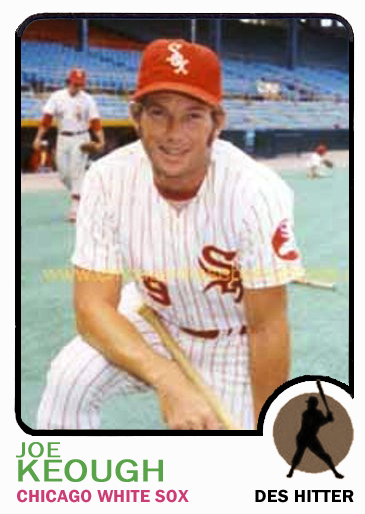
Keough's first at bat in the majors, in 1968, resulted in a home run off of Yankee reliever Lindy McDaniel.  In the expansion draft he was taken by the Royals where he he played for the next 4 seasons.  Chicago acquired him in the off-season and sent him to AAA-Iowa where he hit .258 with just 4 homers in 108 games.  He played in just 5 games for the parent club and went 0 for 1.
Jeter came to Chicago figuring he was going to be the starting centerfielder.  When Ken Henderson arrived from San Fran those hopes were dashed.  In 300 AB's spread among all 3 OF positions he hit .240 with 7 longballs.  1974 would find him on his 4th team (CLE) in 6 years.  He barely touched the field at the "mistake by the lake" having spent 76 games down in AAA, where he hit .285.  For the next two seasons he was out of baseball completely.  He resurfaced in 1977 in Tampico of the Mexican League and again in 1979 in Santo Domingo of the ill fated IAML.
Drafted by the White Sox in the fifth round of the 1966 Major League Baseball draft, Frailing spent seven seasons in the ChiSox farm system before his recall in the closing weeks of the 1972 season. He appeared in four games in relief that year, then ten more in 1973 during a year largely spent with the Triple-A Iowa Oaks. However, his success in the minor leagues that season — he won 11 of 14 decisions with a stellar 2.86 earned run average and was named to the official American Association All-Star Team — attracted the attention of the crosstown Cubs, who asked that Frailing be included in the blockbuster Ron Santo trade that off-season.
After hitting .409 (45 for 110) with 11 homers and 28 RBI's in August of 1972 Henderson caught the White Sox eye.  His present team, the Giants thought that this would be the best time to trade him and get equal value, so they could clear room for Gary Matthews.  The switch hitting Henderson was an above average hitter and fielder, but he had the audacity to come up short of expectations, which were simply to be the man to replace Willie Mays.  OK, nobody was Mays before Mays, and nobody has been Mays after Mays.  Simply put saying someone is going to be the next Willie Mays is like putting a curse on his career.  The White Sox had more modest goals for Henderson.  They just wanted him to be their everyday centerfielder and hit about 15 homers.  After winning the starting job in spring training things were going according to plan.  Henderson was hitting a more than acceptable .311 with 2 homers when he got injured in late May and missed well over a month of action.  He returned on July 1st and played about a month, but couldn't get healthy.  His season was done on August 7th and his final #'s were .260-6-32 in just 73 games.

Thanks to this Topps Vault photo I was able to rescue Alvarado from a horrible horizontal card where it looks like he's playing pick up ball on a crappy sandlot right next to a parking lot.  You can't even make out if it's actually him playing.  I think if you zoom in closely you can see Coach Buttermaker sitting in a '59 Caddy sipping Budweisers.  Pimba was in his 3rd season as the White Sox's primary utility infielder.  He hit .232 in what would turn out to be his last full season in Chicago before packing his bags to head to 5 different teams in 4 years.
Andrews started the season in Chicago and was one tick above the Mendoza line when the team released him on July 16th.  15 days later the defending champion Oakland A's picked him up off the scrap heap to help them with their infield woes.  This was a 29 year old Andrews, who was nothing like the sure handed 23 year old version that hit .308 for the Red Sox in the '67 Series.  This Andrews would go on to make some big errors for the A's in the Series and spark controversy when owner Charlie Finley forced him to say he was injured so he could be replaced on the active roster.  Andrews wouldn't perjure himself and the commissioner of baseball reinstated him.  That event sealed his fate with the A's and he was released minutes after the last cork was popped from championship bubbly.  After sitting out the full 1974 season he took a trip to the far east and played one sub par season for Kinetsu of the Japanese league.
Harvard grad Pete Varney was promoted from AAA-Iowa after hitting 18 homers in 350 AB's. He went 0-4 with a walk in his brief cup of Joe in Comiskey.  1974 was a repeat of 1973.  1975 saw him get 107 AB's and hit .271.  That would be the apex of his major league career.  The following season he split time between the Chisox and Atlanta's AAA-Richmond, where he spent the full '77 season.  After hitting .285 with 10 homers he was treated more like a suspect than a prospect and released.
On July 27th, 1973 Chicago's GM Stuard Holcomb resigned.  A day later the team cut Reichardt, who at the time was hitting .275.  The new GM must have had a crystal ball or something, because 7 days later his castoff was picked up by the Royals and hit just .220. The following season he would get one AB and was out of baseball.  Amazing how fast one can fall from grace in a competitive sport like baseball.  Reichardt was a huge 2 sport star at Wisconsin and even started at fullback in the Rose Bowl.  In 11 major league seasons he hit .261 with 116 homers during an offensively challenged era of the mid 60's to early 70's.
Sam Ewing was hitting .292 with 12 homers in AAA-Iowa when the big club promoted him in September.  After hitting just .150 (3-20) in 11 games it was determined that he needed more seasoning.  After 2 more successful seasons in AAA he was given another cup of Joe and again he came up short.  Chicago believed he was a classic AAAA player and left him unprotected in the expansion draft where he was selected by Toronto.  The Jays looked like geniuses when he hit .287 for them during their inaugural season, but like water mediocre players seek their level and Ewing's level was about .179, which is what he hit in 1978 before being farmed out to AAA-Syracuse.  Toronto decided to part company with the 29 year old, who took his talents to Japan for one solid season.  Hoping to catch lightning in a bottle he signed a minor league deal with his old team the White Sox who sent him back to his old Iowa stomping grounds.  In 30 games he hit a cool .337, but did not get a call to return to the windy city.

Stoney was a flop in 2 seasons in San Fran and was a throw in along with Ken Henderson in a preseason trade.  Stone went 6-11, 4.24 in 22 starts and was shipped crosstown to the Cubbies as part of the Santo deal the following season.  After 3 decent seasons on the Northside of town he wound up back on the Southside of town for two solid years.  Then it was of to Baltimore where he got to pitch for a pennant winner in 1979 and at 32 years of age in 1980 he won the AL Cy Young Award with a 25-7, 3.23 record.  The following season he hurt his arm and was out of baseball as an active player.  Stone eventually caught on with the Cubbies as Harry Caray's sidekick in the broadcast booth.